What’s Inside
- The Foundation: Gentle Cleansing
- Sunscreen is Non-Negotiable, Even Indoors
- Embrace the 2026 Trend of Skin Cycling
- Hydrate Strategically with Hyaluronic Acid
- Start Retinoids Early for Long-Term Benefits
- Prioritize Skin Barrier Repair with Ceramides
- Extend Skincare to Your Neck and Chest
- Adopt Microbiome-Friendly Skincare Habits
- Target Dark Circles with Specific Ingredients
- Practice Skinimalism
Last Tuesday at Whole Foods, I caught my reflection in the organic produce glass and realized my face looked like a molting lizard. I’ve spent years hunting down beauty secrets, yet there I was, peeling under fluorescent lights because I’d messed up my moisture barrier again. I’m Kailyn Cora, and if you’re reading this, you probably know the exact feeling of buying a trendy serum only to have it break you out three days later. It’s frustrating. It’s expensive. And honestly, it’s exhausting trying to figure out what actually works.
I’m skipping the fluff today. You won’t find any complicated 15-step routines here. Instead, I’m sharing the exact products, measurements, and hard-learned lessons that actually fixed my skin. I did this wrong for months before figuring it out. Took me years, really. I clearly remember standing in the checkout line holding a $9 green juice, feeling defeated by my dry, flaky chin. The cashier definitely noticed. That was my wake-up call to stop blindly following viral videos and start paying attention to the actual science of skin. I’ve wasted hundreds of dollars on fragrance-free, joy-free lotions that felt like rubbing wet cardboard on my face. Skip the fat-free stuff. Your skin needs lipids. It needs moisture. It needs a routine that doesn’t require a spreadsheet. Grab a coffee or a matcha, and let’s talk about the real changes you can make tonight.
1. The Foundation: Gentle Cleansing

Most people get this wrong right out of the gate. I know I did. For years, I scrubbed my face with harsh foaming gels until my skin felt tight and squeaky. That squeaky feeling is bad. It means you’ve stripped your natural oils. A few weeks ago, I was wandering the aisles at Target, looking at the overwhelming wall of face washes. I finally grabbed the CeraVe Hydrating Facial Cleanser (around $15-$18 for a 16 oz bottle). It changed everything. The texture is like a milky lotion. It doesn’t foam at all. At first, I hated it because it didn’t feel like it was working. That’s the point. You only need a nickel-sized amount for your whole face. If you’ve got super sensitive skin, drop that down to a pea-sized amount. Massage it in for a full 60 seconds. Count it out in your head. Rinse with lukewarm water, never hot. Hot water melts your skin barrier like butter in a microwave. I cleanse twice daily, but if you don’t wear makeup, just washing at night is fine. The goal is to remove the day’s grime without leaving your face feeling like a stretched rubber band. It’s a simple switch. I’ve learned that if your face feels dry within five minutes of washing, your cleanser is too harsh. Toss it. Don’t even finish the bottle. Use it to wash your makeup brushes instead. It’s so easy to ruin your face with a bad cleanser. Trust me.
2. Sunscreen is Non-Negotiable, Even Indoors

I used to think sunscreen was only for beach days. Huge mistake. Two years ago, I spent six months working at a desk right next to a massive window. I loved the light. My skin did not. I ended up with a cluster of dark sun spots on the left side of my face. UVA rays penetrate window glass effortlessly. Now, daily SPF is my absolute non-negotiable step. I personally swear by EltaMD UV Clear Broad-Spectrum SPF 46. It costs around $40-$45 for a 1.7 oz airless pump bottle. Yes, it’s pricey. But it’s worth every penny. It has a lightweight, whipped texture that doesn’t smell like a public pool. It doesn’t leave a chalky white cast, and it plays perfectly under my concealer. You need to apply exactly 1/4 teaspoon for your face, and another 1/4 teaspoon for your neck. Measure it out once just to see what that actually looks like. It’s way more than you think. You’re probably under-applying. I definitely was. And if you’re sweating or sitting outside, you need to reapply every two hours. I keep a spare bottle in my car console just in case. Don’t rely on the SPF in your foundation. You’d have to apply a terrifyingly thick layer of makeup to get the actual protection listed on the bottle. Just use a dedicated sunscreen. I’ve tried cheaper ones, but they always broke me out or made me look greasy by noon. Protect your investment. Sun damage is cumulative. You might also like: 15 Lovely Tips Korean Skincare That Changed Everything
3. Embrace the 2026 Trend of Skin Cycling

If you’re slapping on five different strong serums every night, please stop. I burned my face off last year trying to use an exfoliator and a strong retinoid in the same routine. My cheeks were bright red and stinging for a week. That’s when I discovered skin cycling. It’s a 4-night routine that gives your skin a chance to recover. Night one is for exfoliation. I use a liquid BHA on a cotton pad. Night two is for retinoids. I highly recommend starting with something gentle, like Paula’s Choice 0.3% Retinol + 2% Bakuchiol Treatment. It runs about $50-$60 for a 1 oz bottle. It has a creamy, yellow-tinted texture that absorbs instantly. Nights three and four are strictly for recovery. No active ingredients. Just pure hydration. I slather on the thickest, blandest creams I can find. I was at Sprouts last month and picked up some pure vegetable glycerin to mix into my moisturizer on recovery nights. It’s sticky, but it works miracles. This rotating schedule prevents you from destroying your skin barrier. It’s the ultimate way to get the benefits of strong ingredients without the constant peeling. I’ve noticed my texture is so much smoother since I stopped attacking my face with acids every single night. Give your skin a break. It needs days off just like you do. Patience yields better results than chemical burns. Skin cycling literally saved my complexion. You might also like: 15 Beautiful Aesthetic Morning Skincare for Any Style
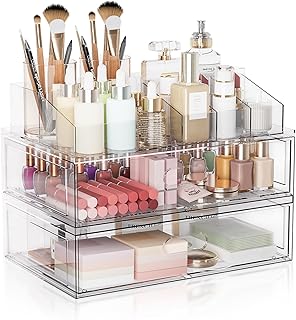
Clear Stackable Makeup Organizer with Drawer
Clear Stackable Makeup Organizer with Drawer has been one of the most consistently praised picks in this category. 302 reviewers averaged 4.5/5.
4. Hydrate Strategically with Hyaluronic Acid

Here’s a massive mistake I made for years. I’d wash my face, dry it completely, and then rub hyaluronic acid onto my bone-dry skin. Then I wondered why my face felt tighter than before. Hyaluronic acid acts like a sponge. It holds 1000 times its weight in water. But if there’s no water on your skin, it pulls moisture out of the deep layers of your own face. It literally dehydrates you. You must apply it to damp skin. I keep a little spray bottle of water on my counter just for this. I mist my face, then apply exactly 2-3 drops of The Ordinary Hyaluronic Acid 2% + B5. It’s stupidly cheap, around $7-$8 for a 1 oz dropper bottle. You can usually find it at Target or Ulta. The texture is slightly viscous, almost like a thin syrup. It glides over damp skin beautifully. But you aren’t done yet. You must lock that hydration in immediately. Within 60 seconds, you need to apply a layer of moisturizer to seal it all down. If you don’t seal it, the water just evaporates into the air, taking your natural moisture with it. I figured this out the hard way while standing in the Walmart beauty aisle, reading a random science blog on my phone. Damp skin, acid, moisturizer. That’s the holy trinity. I’ve never gone back to applying serums on dry skin. You might also like: 15 Charming Aesthetic Pictures Skincare Worth Trying This Year
5. Start Retinoids Early for Long-Term Benefits

Don’t wait until you’ve got deep wrinkles to start using retinoids. I always thought they were only for older women, but dermatologists agree that starting in your twenties or thirties is the best preventative measure you can take. I started my retinoid experience with a generic adapalene gel I found in the Kroger pharmacy aisle. It was a disaster at first. I used way too much, way too fast. I applied a huge glob every night. By day four, the skin around my mouth was flaking off in sheets. It looked like I had powdered sugar on my chin. It was mortifying. The trick is to start incredibly slow. Find a low-strength formula, around 0.1% or 0.25%. Apply a tiny, pea-sized amount for your entire face just two nights a week. Put a layer of plain moisturizer down first, then the retinoid, then another layer of moisturizer. It’s called the sandwich method, and it saves you from the dreaded retinol uglies. Retinoids speed up your cellular turnover and boost collagen production. They’re the gold standard for a reason. But you’ve got to respect them. They aren’t a quick fix. It takes about three to six months of consistent use to see real changes in your skin’s firmness and clarity. I’m telling you, push through the annoying learning curve. Your future face will thank you. Just remember to skip the areas right around your nostrils and the corners of your lips, as those spots peel the fastest.
6. Prioritize Skin Barrier Repair with Ceramides

Your skin barrier is like the brick-and-mortar protecting your house. If the mortar crumbles, the bad stuff gets in and the water leaks out. When my barrier is compromised, everything stings. Even plain water feels like acid. That’s when I drop all active ingredients and focus entirely on lipids and ceramides. I recently discovered the Lion Pose Pep Talk Barrier Repair Cream. It’s around $40-$50 for a 1.7 oz tube. It’s packed with ceramides and fatty acids, and the texture is dense but melts into the skin without feeling greasy. If you want a budget option, nothing beats the classic CeraVe Moisturizing Cream in the giant tub. It’s about $15-$18 for a 16 oz tub. I buy mine at Costco because I go through it so fast. Here’s a crucial tip I learned from a dermatologist: you’ve got exactly a five-minute window after you get out of the shower to apply your body and face lotion. If you wait longer, the ambient air starts pulling moisture out of your warm, damp skin. I used to wander around in my towel for twenty minutes before doing my routine. Huge mistake. Now, I keep my CeraVe tub right on the bathroom counter. I slap it on while the bathroom is still steamy. It traps all that ambient humidity right into my skin. It makes a massive difference in how soft my face feels the next morning. Never underestimate the power of a basic, boring cream.

Vtopmart 3 Tier Clear Makeup Organizer with Drawer
Honestly, Vtopmart 3 Tier Clear Makeup Organizer with Drawer surprised me — sturdier than it looks in the photos, and over 19 buyers gave it 4.5 stars.
7. Extend Skincare to Your Neck and Chest

I clearly remember looking at a photo of myself at a friend’s wedding and realizing my face was a smooth, even tone, but my neck and chest were red, blotchy, and visibly older. It looked like my head was pasted onto someone else’s body. I’d completely neglected everything below my jawline for years. Whatever products you apply to your face, you absolutely must drag them down to your neck and décolletage. That includes your serums, your moisturizers, and especially your sunscreen. The skin on your neck is incredibly thin and delicate. It shows signs of aging and sun damage much faster than your face. I was at Trader Joe’s last summer and grabbed a cheap, basic sunscreen just to keep in my purse for my chest. It smells slightly like coconuts and costs practically nothing. I make sure to apply a thick layer from my collarbones up every single morning. Reversing sun damage on the chest with expensive lasers is incredibly painful and rarely looks as good as prevention. I learned this the hard way. Now, I treat my face, neck, and chest as one single unit. When I dispense those 2-3 drops of hyaluronic acid, I make sure there’s enough slip to coat my neck too. It takes an extra five seconds, but it prevents that mismatched, two-toned look that gives away your age instantly. Don’t let your neck tell secrets your face is trying to hide.
8. Adopt Microbiome-Friendly Skincare Habits

We need to talk about the bacteria on your face. I know it sounds gross, but your skin has a natural ecosystem called the microbiome. When you use harsh, alkaline soaps, you nuke the good bacteria along with the bad. I used to wash my face with literal bar soap. I know, I’m cringing just typing that. My skin was constantly breaking out and felt rough to the touch. The ideal pH for your skin is slightly acidic, hovering between 4.5 and 5.5. When you disrupt that, bad bacteria thrive. I’ve been researching the Revision Skincare DEJ family of products recently. They’re specifically formulated to support your microbiome with prebiotics and postbiotics. They’re definitely on the pricier side, often over $100, but the science behind them is fascinating. If you’re on a budget, just focus on avoiding products with harsh sulfates like SLS. I spent an hour reading labels in the natural beauty aisle at Whole Foods last month, and it’s shocking how many gentle cleansers still contain harsh detergents. You want products that feed your skin’s natural defenses. Look for ingredients like oat extract, fermented ingredients, and gentle hydrators. Since I started treating my skin like a delicate garden instead of a dirty frying pan, my chronic redness has almost completely vanished. It’s all about balance. Stop trying to sterilize your face. It isn’t a surgical instrument. Let your natural oils do some of the heavy lifting.
9. Target Dark Circles with Specific Ingredients

For the longest time, I was convinced that all eye creams were just overpriced moisturizers in tiny jars. I refused to buy them. But then I started noticing deep, purple shadows under my eyes that made me look like I hadn’t slept in a decade. Concealer was just creasing and making it look worse. I finally caved and started looking for targeted active ingredients. If you’ve got dark circles caused by thin skin and visible blood vessels, you need specific ingredients like caffeine to constrict the vessels, and Vitamin K to improve circulation. I picked up the Minimalist Vitamin K + Retinal 0.1% Eye Cream online. It’s super affordable, around $15-$20 for a 0.5 oz tube. It has a slightly yellowish tint and a very light, gel-cream texture. I tap exactly half a pea-sized amount under both eyes using my ring finger. Never rub or drag the skin there. It’s too fragile. I apply it every night, and the caffeine really helps depuff the area by morning. It isn’t a magical eraser. You won’t wake up looking like a filtered Instagram model. But it definitely lightens the purple shadows and smooths out the fine lines so my concealer actually sits flat. I’m officially eating my words. A good, targeted eye cream is absolutely worth the extra step in your routine. Just make sure you’re buying one with actual active ingredients, not just expensive wax.

SeoulCeuticals Korean Skin Care 20% Vitamin C Hyaluronic
Honestly, SeoulCeuticals Korean Skin Care 20% Vitamin C Hyaluronic Acid Serum + surprised me — sturdier than it looks in the photos, and over 273 buyers gave it 4.5 stars.
10. Practice Skinimalism

We’re officially done with the era of 15-step skincare routines. It’s exhausting, it’s expensive, and honestly, it’s probably ruining your face. I used to layer a toner, an essence, three different serums, a lotion, an oil, and a sleeping mask every single night. My pores were so clogged I could barely recognize my own texture. I was breaking out constantly. That’s when I embraced skinimalism. You really only need four basic steps: cleanse, treat, moisturize, and protect. That’s it. I also learned to adjust my moisturizer based on the season. In the sweltering heat of July, I switch to the Neutrogena Hydro Boost Water Gel Fragrance Free. It’s around $15-$20 for a 1.7 oz jar at Walmart. It feels like a splash of cold water and sinks in instantly without leaving a greasy film. But in the dead of winter, when the heater is blasting and the air is bone dry, I pull out the heavy artillery. I use the First Aid Beauty Ultra Repair Cream. It costs about $38-$40 for a 6 oz tub. It has colloidal oatmeal and a thick, rich texture that smells vaguely like plain oats. It immediately calms down wind-chapped skin. Pare back your routine. Stop overwhelming your pores. Your skin is remarkably good at taking care of itself if you just give it the right basic tools and get out of its way. Less really is more. I’ve saved so much money and counter space since I stopped hoarding unnecessary serums.
I really hope these tips help you avoid the frustrating mistakes I’ve made over the years. Skincare isn’t about buying the most expensive products in the prettiest glass bottles. It’s about understanding how ingredients work, applying them correctly, and being incredibly consistent. I’ve completely changed my skin just by changing the temperature of the water I wash with and measuring out my sunscreen. It doesn’t have to be complicated. If you found this helpful, I’d love it if you saved this post or pinned it to your beauty boards so you can reference it later. I’m always tweaking my routine, so I’ll keep updating you on what’s actually working. Remember, your skin is unique, so take what works for you and leave the rest. Don’t stress over achieving absolute perfection. Just aim for healthy, hydrated, and protected. Have a great night, and go wash your face!
Frequently Asked Questions
What are the best daily skincare tips beauty secrets for beginners?
Start with a gentle cleanser, a basic moisturizer, and a broad-spectrum SPF 30 sunscreen. Don’t overcomplicate it. Consistency with these three steps yields better results than using fifteen different serums sporadically.
How long does it take for skincare tips beauty secrets to show results?
Basic hydration shows overnight, but active ingredients like retinoids or Vitamin C take three to six months of consistent use to visibly change your skin’s texture and firmness. Patience is absolutely required.
Are expensive skincare tips beauty secrets worth the money?
Not always. You can find incredible cleansers and moisturizers at the drugstore. I’d recommend saving your budget for high-quality sunscreens and targeted active serums, rather than splurging on wash-off products.
Why aren’t my current skincare tips beauty secrets working?
You’re likely dealing with a damaged skin barrier from over-exfoliation, or you aren’t applying products correctly—like using hyaluronic acid on dry skin. Simplify your routine and focus entirely on barrier repair first.
