What’s Inside
- Selecting the Right Hardware for a Skincare Fridge Aesthetic
- Temperature Control and Ingredient Stability
- Organizing by Molecular Weight and Daily Use
- The Role of Facial Tools in Your Setup
- Managing Moisture and Condensation Issues
- Curating Sheet Masks for the Skincare Fridge Aesthetic
- What Never to Put in Your Cooling Unit
- Cable Management and Placement Strategy
- Rotating Seasonal Products and Expiration Dates
- Cleaning Protocol for a Sterile Environment
Last July, I opened my bathroom cabinet and found my $166 SkinCeuticals CE Ferulic oxidized into a dark, sticky syrup smelling faintly of hot dog water. The summer heat in my second-floor apartment had completely degraded the L-ascorbic acid. That expensive mistake forced me to figure out a proper skincare fridge setup that actually functioned as a temperature-controlled preservation system. Most people buy a tiny plastic cooler, stuff it with random jars, and call it a day. I approach this differently. As a product researcher, I need my formulas to remain stable, active, and free of bacterial overgrowth. A functioning setup requires specific hardware, exact temperature monitoring, and a logical spatial arrangement based on product viscosity. You aren’t just creating a cute display for your vanity. You’re building a controlled microclimate to protect volatile chemical compounds from heat and light degradation. Let’s break down exactly how to construct a system that protects your investments while looking visually organized. I’ll show you the exact dimensions, the specific temperatures you need to maintain, and the common mistakes that will ruin your expensive creams if you aren’t careful.
1. Selecting the Right Hardware for a Skincare Fridge Aesthetic

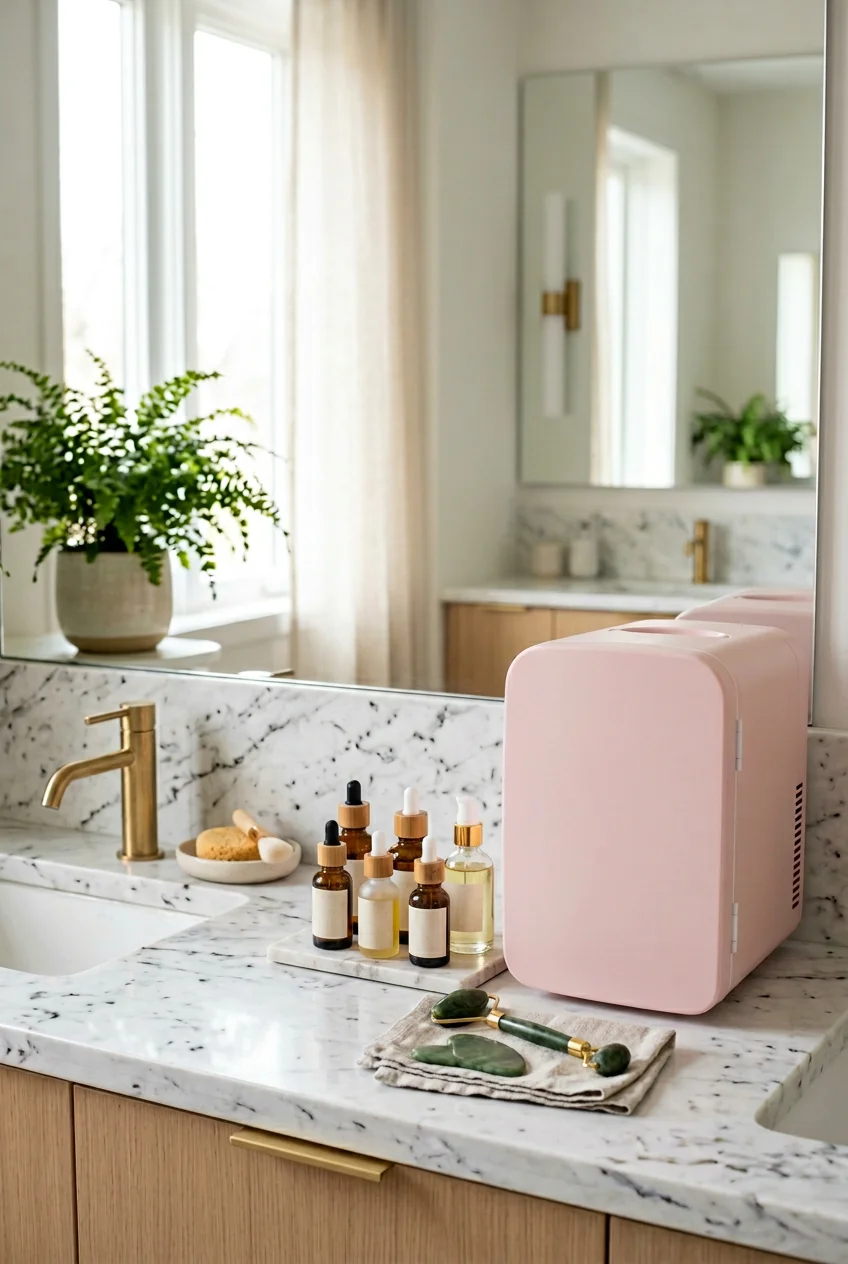
I tested four different models before settling on the Cooluli 10L Infinity. It costs $79.99 at Target and measures exactly 9.4 by 11.4 by 13.4 inches. You’re going to see a lot of 4L micro-fridges marketed heavily on social media. Skip them. I tried one last October, and it barely held two 4 oz moisturizers and a jade roller. The 10L size provides enough cubic inches for vertical serum bottles and horizontal sheet mask stacks without blocking the internal air circulation. The Cooluli model uses a thermoelectric cooling system, relying on the Peltier effect rather than a traditional Freon compressor. It maintains an internal temperature of roughly 35 to 40 degrees Fahrenheit, depending on your room’s ambient heat. The back fan emits a low, continuous hum at 28 decibels. It’s noticeable in a dead-silent room, but it fades into white noise quickly. If you’re placing this in a bedroom, you need to consider that constant mechanical sound. A common mistake is buying a unit with a completely opaque plastic door. I prefer the glass-front models. Being able to see the inventory without opening the door prevents unnecessary temperature fluctuations. Every time you open the latch, warm air rushes in, forcing the small motor to work harder to stabilize the environment. You want to keep that door shut as much as possible. Trust me on this.
2. Temperature Control and Ingredient Stability

The primary function of this appliance is chemical preservation. Vitamin C, retinol, and benzoyl peroxide degrade rapidly when exposed to heat and UV light. I keep my 1 oz bottle of Mad Hippie Vitamin C Serum ($33.99 at Sprouts) on the middle shelf where the temperature is most consistent. The cold environment actively slows down the oxidation process. You aren’t just chilling products for a refreshing physical sensation. You’re extending the shelf life of highly volatile compounds. However, colder isn’t always better. Last winter, I pushed my unit too close to the wall, which caused the internal thermostat to malfunction. The temperature dropped below 30 degrees. My 1.7 oz jar of Dr. Jart+ Ceramidin Cream ($48.00 at Sephora) froze completely solid. The emulsion broke under the thermal stress. When it thawed out on my counter, the water and oil phases separated into a lumpy, unusable mess that I had to throw away. You must monitor the internal climate constantly. I bought a basic Taylor analog refrigerator thermometer for $5.99 at Walmart and keep it permanently on the bottom rack. The ideal zone is between 40 and 50 degrees Fahrenheit. If it drops lower, your thicker emulsions will destabilize. If it goes higher, you lose the preservation benefits for your active ingredients. You might also like: 12 Aesthetic Skincare Photography You Need to See
3. Organizing by Molecular Weight and Daily Use

A functional skincare fridge aesthetic relies on a strict spatial hierarchy. I organize my shelves based on two factors: product viscosity and frequency of use. Heavy creams and dense sleep masks go on the bottom shelf. Watery toners and lightweight serums sit on the top shelf. This mimics the actual order of a skincare routine, moving from thinnest to thickest consistencies. I use a 4 oz bottle of Good Molecules Niacinamide Brightening Toner ($14.00 at Ulta). It sits front and center on the top rack because I reach for it twice a day. Products I use only once a week, like my 1.7 oz jar of Paula’s Choice BHA Liquid Exfoliant ($34.00), sit in the back left corner. To maximize vertical space, I use small clear acrylic risers. I bought a set of three 3×3 inch stands for $4.99 at The Container Store. They allow me to stack shorter 1 oz serum dropper bottles behind taller 5 oz toner bottles without losing visibility. If you just shove everything in randomly, you’ll end up knocking over fragile glass bottles every time you reach for your eye cream. Methodical placement prevents breakage, speeds up your morning routine, and ensures the cold air circulates evenly around every single container.

EQQUALBERRY Vitamin Illuminating Serum | Niacinamide 4% +
A dependable everyday pick — EQQUALBERRY Vitamin Illuminating Serum | Niacinamide 4% + Brightening pulls in 112 ratings at 4.5 stars. Not flashy, just solid.
4. The Role of Facial Tools in Your Setup

Cooling facial tools is one of the few purely physical benefits of this setup. Cold temperatures constrict blood vessels, which reduces morning facial swelling and lymphatic fluid buildup. I keep a Mount Lai Jade Roller ($34.00 at Sephora) and a stainless steel gua sha tool on the interior door shelf. The door is slightly warmer than the main compartment, which is actually ideal for solid tools. I learned that the hard way last Tuesday. I left a solid metal eye roller on the back wall of the cooling plate overnight. The next morning, the metal was so cold it actually stuck to the delicate skin under my eye, causing a minor friction burn when I pulled it away. You want your tools cold, not freezing. I dedicate exactly two minutes to rolling my jawline and under-eyes after applying a thick layer of Cosrx Advanced Snail 96 Mucin Power Essence (3.38 oz, $25.00 at Ulta). The cold stone glides easily over the viscous mucin, pushing the stagnant fluid toward the outer edges of my face. Keep your tools in a dedicated plastic tray so they won’t roll around and smash into your glass serum bottles when you swing the door open.
5. Managing Moisture and Condensation Issues

Thermoelectric coolers generate condensation. It’s an unavoidable physical byproduct of pulling moisture out of the air as the unit cools down. If you ignore this, water will pool at the bottom of your unit and breed black mold. I discovered this gross reality about three months into using my very first unit. I had a cardboard box of five Dr. Jart+ Cryo Rubber Masks ($14.00 each) sitting directly on the bottom shelf. The cardboard soaked up a hidden puddle of condensation, turned black with mildew along the bottom edge, and ruined the entire batch. Now, I implement strict moisture control. I fold a standard white paper towel and place it flat across the bottom plastic floor of the unit. I replace this towel every Sunday morning. It absorbs any stray water droplets before they can accumulate into a puddle. For extra humidity control, I keep a small 8 oz box of Arm & Hammer Baking Soda ($1.19 at Kroger) in the back corner. I punch three small holes in the top of the cardboard box. It absorbs ambient moisture and neutralizes the faint chemical smell that sometimes builds up when storing multiple fragranced lotions in a tightly confined, unventilated space. You might also like: 15 Gorgeous Aesthetic Glass Skin That Changed Everything
6. Curating Sheet Masks for the Skincare Fridge Aesthetic

Sheet masks are the most common item people refrigerate, but most people store them incorrectly. If you stand your sheet masks upright like books on a shelf, gravity pulls all the liquid essence down to the bottom of the foil pouch. When you open it, the top half of the cotton mask will be completely dry, and the bottom will be dripping wet. You must store them completely flat. I clear out the middle shelf entirely for flat storage. I currently have a stack of ten Mediheal Teatree Care Solution Essential Masks. I buy them in bulk boxes for $19.90 at H Mart. The cold temperature makes the tea tree extract feel incredibly soothing on active, inflamed breakouts. Stacking them flat ensures the viscous serum remains evenly distributed across the entire cellulose sheet. I strictly limit my inventory to ten masks at a time. Any more than that, and the stack becomes physically unstable and blocks the airflow from the back fan. If the air can’t circulate around the plastic pouches, the unit struggles to maintain its baseline temperature, and the internal motor will burn out significantly faster. You might also like: 15 Skincare Products That Actually Work
Clear Stackable Makeup Organizer with Drawer
If you want something that just works, Clear Stackable Makeup Organizer with Drawer is a safe bet (310 reviews, 4.5 stars).
7. What Never to Put in Your Cooling Unit

Not everything belongs in a cold environment. In fact, refrigerating certain formulas will completely ruin them. You shouldn’t ever put cleansing balms, facial oils, or heavy silicone-based primers in your unit. Last November, I put a 3.38 oz tub of Banila Co Clean It Zero Cleansing Balm ($19.00 at Ulta) on the bottom shelf, thinking the cold would keep it fresh. Three days later, I tried to scoop out a dime-sized amount with the included plastic spatula. The polyethylene wax in the balm had hardened into a solid block. The spatula snapped in half from the pressure. Facial oils are just as problematic. I put a 1 oz bottle of The Ordinary 100% Organic Cold-Pressed Rose Hip Seed Oil ($10.90 at Sephora) in the door rack. The cold caused the lipids to coagulate. The oil turned cloudy and thick, and the glass dropper completely clogged. These lipid-heavy products are formulated by chemists to remain stable at room temperature. The cold alters their physical state, and repeated cycles of solidifying and melting will eventually degrade the preservative system. Keep your oils, balms, and heavy silicone products in your standard bathroom cabinet where they belong.
8. Cable Management and Placement Strategy

Where you physically place the unit matters just as much as what you put inside it. These appliances require proper ventilation to function safely. The exhaust fan is located on the back panel, and it constantly expels warm air. If you push the unit flush against a wall, the hot air has nowhere to go. The motor will overheat, and the internal cooling mechanism will fail. I ruined my first unit this way by shoving it tightly into a wooden bookshelf. Now, I keep my current model on a sturdy vanity desk, exactly three inches away from the drywall. The power cord is thick and bulky. I’d strongly suggest measuring your desk depth before buying to ensure you have enough clearance. To keep the visual setup clean, I use 3M Command Cord Clips. A pack of four costs $3.48 at Walmart. I stick them to the back leg of my vanity and route the thick black power cable down to the floor outlet, completely out of sight. A clean exterior is just as important as an organized interior. If you have thick black wires snaking across your white desk, the entire visual appeal of the setup is ruined. No exaggeration.
9. Rotating Seasonal Products and Expiration Dates

The cold temperature extends the shelf life of your products, but it doesn’t make them immortal. It’s incredibly easy to push a jar to the back of the shelf and forget about it for a year. I use a strict labeling system to prevent this. I bought a Brother P-Touch label maker for $34.99 at Staples. Every time I open a new product, I print a tiny white label with the month and year, and I stick it to the bottom of the jar. This is crucial for products packaged in tubs where you constantly dip your fingers, introducing outside bacteria. I swap my inventory based on the season. In the summer, I stock up on gel-based hydrators. I keep a 2.5 oz jar of Trader Joe’s Watermelon Overnight Face Mask ($6.99) front and center. The cold gel is highly effective at cooling down sun-exposed skin. In the winter, I cycle the gels out and replace them with thicker barrier repair creams containing ceramides. I ruthlessly throw away anything that has been open for longer than twelve months, regardless of how much expensive product is left in the container.

medicube Deep Vitamin C Capsule Serum | Hydrating Vitamin C
A dependable everyday pick — medicube Deep Vitamin C Capsule Serum | Hydrating Vitamin C Serum for pulls in 298 ratings at 4.5 stars. Not flashy, just solid.
10. Cleaning Protocol for a Sterile Environment

A damp, enclosed space is a breeding ground for bacteria, which is the exact opposite of what you want near your face. You have to clean the interior regularly. I have a strict ten-minute cleaning protocol that I execute every single Sunday morning. First, I unplug the power cord from the wall. I remove all the bottles, jars, and acrylic shelves. I use Seventh Generation Disinfecting Wipes ($6.49 for a 70-count cylinder at Whole Foods) to scrub the plastic walls, the floor, and the rubber gasket around the door seal. The rubber gasket is where dust and spilled serum tend to accumulate and turn into a sticky black sludge. After wiping everything down, I take a dry microfiber cloth and wipe away all the chemical residue from the disinfecting wipe. You can’t leave the interior wet. If you plug it back in while the walls are damp, you’ll immediately create a massive condensation problem. I wait five minutes for the plastic to air dry completely before replacing the shelves and restocking the products. It’s a tedious chore, but it absolutely prevents cross-contamination. Took me years to figure out.
Building a proper setup requires more than just buying a pink plastic box and filling it with random jars. You have to consider the chemical stability of your formulas, the physical dimensions of your storage space, and the daily maintenance required to keep the environment sterile. I’ve used my current configuration for over two years now, and the strict temperature control has noticeably extended the lifespan of my expensive Vitamin C serums. If you follow these exact parameters, you’ll avoid the messy condensation puddles and frozen creams that plague most beginners. Pin this guide to your aesthetic vanity boards so you have the exact dimensions and temperature ranges handy when you’re ready to set up your own unit.
Frequently Asked Questions
What temperature should a skincare fridge be?
Keep it between 40 and 50 degrees Fahrenheit. If it drops below 35 degrees, heavy emulsions and creams will freeze and separate. If it goes above 50 degrees, you lose the chemical preservation benefits for active ingredients like Vitamin C.
Can I put cleansing balms in my mini fridge?
No. Cleansing balms contain waxes and heavy oils that solidify in cold temperatures. The formula will turn into a hard block, making it impossible to scoop out, and repeated temperature fluctuations will eventually degrade the product.
How do you stop condensation in a beauty fridge?
Thermoelectric coolers naturally pull moisture from the air. Place a folded paper towel on the bottom shelf to absorb puddles, and keep a small perforated box of baking soda in the back corner to control ambient humidity. Wipe the interior weekly.
Should sheet masks be stored flat or upright?
Always store sheet masks completely flat. If you stand them upright, gravity pulls the liquid essence to the bottom of the pouch, leaving the top half of the cotton mask dry and ineffective when you open it.
